


Last week, while driving my son to school, I tried to explain something strangely simple and strangely slippery.
Money is not what is valuable.
It is the shadow of our activity.
A shadow is real enough to measure, but never real enough to touch. Money behaves the same way. It reflects something upstream, yet it is never the thing itself. We measure it, chase it, fear it, and sometimes even worship it, even though it can only ever reveal an outline of the life that produced it.
That is where this conversation began: a quiet moment in the car, trying to name something I wish someone had named for me years ago.
The Strange Thing About Shadows
If you stand in sunlight, your shadow stretches and bends in ways that resemble you without ever matching you. It moves when you move, lengthens as the light fades, and disappears when the sun drops. It is connected to you, yet it is not you.
Money works in exactly this way.
It is the downstream outline of upstream activity, a silhouette of value.
You can learn something from it, but not everything.
Somewhere along the way, we began to confuse the outline for the substance. Entire institutions grew around the practice of measuring shadows. And shadows, as it turns out, are just accurate enough to keep our trust and just inaccurate enough to distort our choices.
Money can show that something happened.
It cannot show who was affected, or how trust shifted, or whether harm or healing took place, or whether the future became safer or more fragile.
Two identical financial results can leave completely different wakes in the world.
This is the hidden glitch in our cultural operating system.
We measure the shadow and ignore the light source.
The Humor We Need Right Now
To see how strange this confusion really is, imagine the metaphor made literal.
Picture yourself stranded on a remote island in the wide silence of the Pacific with nothing but a duffel bag stuffed with crisp, untouched $100 bills. Not survival tools. Not food or shelter. Just the emergency cash you grabbed while fleeing your coastal mansion when the People finally began to question why money and value have been impersonating each other for so long.
Each evening, as the horizon folds into violets and soft pinks and ember-reds, you whisper to your only companion:
“Hmmm… Look, Wilson. The shadow’s getting longer! That must be a good sign. Very strong fundamentals.”
Wilson, your volleyball with a sunburned handprint for a face, tilts gently toward the sky. He seems absorbed in the sunset, the way a wiser friend listens to a song you have forgotten how to hear. He looks puzzled by your fixation on the shadow. His attention rests entirely on the light that casts it.
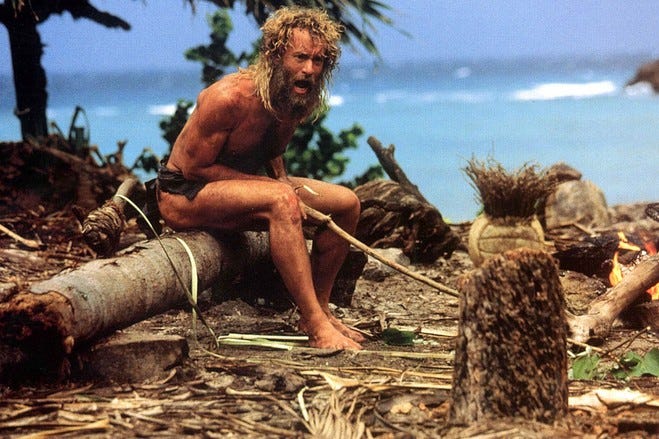
Sometimes you poke the money pile with a stick, as if reviewing quarterly forecasts.
“See, Wilson? The shadow is growing consistently. Very encouraging.”
But the shadow always grows at sunset.
That is not economic growth.
It is geometry.
Our models mistake temporary lengthening for real progress, not because they are evil, but because shadows behave predictably even when we do not.
Eventually the shadow stretches so far it dissolves into darkness. The model breaks. The forecast collapses. And Wilson keeps watching the sky.
Even he seems to know that the beauty is not in the shadow.
It is in the light that creates it.
The Upstream Question
This is what I asked my son:
What is upstream of the money?
What is casting the shadow?
Wilson was watching the light source. That is where all the real questions live.
Sometimes the light is cast by integrity, curiosity, care, creativity, or a desire to serve others. Sometimes it comes from collaboration or a simple commitment to leave things better than we found them.
Other times, the source is different. Sometimes the shadow is cast by extraction, attention manipulation, uneven information, or incentives that reward speed over wisdom. A company producing munitions may generate a massive financial shadow, even as the underlying activity takes lives, destabilizes communities, and weakens the future we all depend on. And yet the harm continues, because the future cannot file a complaint.
Two actions can generate the same number on paper.
One leaves a human-shaped imprint.
The other leaves almost nothing at all.
How We Got Lost in the Shadows
Part of why the world feels disorienting is that we have built massive systems that behave as if the shadow is the thing. Value becomes a number on a ledger. Meaning becomes optional. Impact moves off the ledger and onto society. It remains invisible for a while, but people feel the distortion even when they cannot name it.
A shadow can only say that something happened, and that a number changed.
It cannot tell us whether trust grew stronger, whether communities healed, whether harm accumulated, or whether we acted in alignment with our own values.
Somewhere along the way, we let numbers tell the story that only humans can tell.
Reclaiming the Light Source
Here is the invitation:
Instead of asking how to grow the shadow, we can begin asking about the quality of the light. We can ask what kind of source would create a shadow worth paying attention to.
When the upstream source is shaped by trust, belonging, meaning, creativity, reciprocity, or responsibility for the future, the shadow becomes steady and healthy. Money returns to the supporting role it was meant to play. It becomes a reflection, not the mission.
Systems built this way become resilient.
Communities become stronger.
Wealth becomes something deeper than numbers.
It becomes the ability to support life.
The Agency We Have Been Missing
There is a simple truth hidden inside all of this:
We do not have to accept the shadow as the story.
We get to choose what we stand for, and therefore what kind of shadow our actions cast.
People can choose different values.
Organizations can choose better incentives.
Communities can choose norms that strengthen rather than erode.
Cultures can decide what kinds of stories they reward.
Money will follow.
But it will follow a different source.
And that changes everything downstream.
A Final Thought for Anyone Who Feels This
If something in you has always sensed that our fixation on money feels too thin, too small, too shadow-like, you are not imagining it. You are noticing the difference between a silhouette and a soul.
TheQuietMission exists because enough of us are turning, slowly and quietly, toward the light instead of the outline. We are beginning to ask a different question:
What might be worth building a life around?
What might be worth building a world around?
Money is not the answer.
It never was.
It is only a shadow.
Not all shadows are illusions. Some are cast by True Value: work that strengthens trust, dignity, belonging, fairness, beauty, and flourishing.
Those shadows are worth watching. They are the quiet evidence that something real is happening upstream.
The real shift begins at the light that makes every shadow possible.
The shadow changes when the light does.
If you want to walk with us as we explore the shadows cast by meaningful work and the light that makes them possible…