The Epstein Files | Post 2
=======================================================================
Last time, in The Epstein Files | Post 1, we ended with a simple investigative question.
How did Jeffrey Epstein accumulate so much institutional insulation for so long?
Today, we go one layer deeper.
Before examining individuals, we begin with the system itself. Insulation rarely comes from a single decision or a single person. By “insulation,” we mean the layer of protection a person receives from the way institutions respond to them. It can take many forms: delayed action, unusual leniency, fragmented oversight, or simple reluctance to intervene. Insulation does not require coordination. It can form through habits, incentives, or norms that make it harder for consequences to reach someone who should face them. More often, it grows through the slow alignment of structures, incentives, norms, and blind spots. These elements drift into place over time. Sometimes they protect. Sometimes they obscure. Sometimes they simply fail to respond.
None of this suggests a single coordinated design. It also does not rule out moments of intentional choice. The pattern appears to fall between two extremes: not a plan carried out in unison, and not pure accident. It seems to live in the space where intent and drift overlap.
The Shape of Institutional Insulation
When you look closely at Epstein’s early professional years, before law enforcement entered the picture, you do not find a mastermind directing events. You also do not find a system responding consistently. You see uneven behavior from the institutions around him. Some responded with care. Others hesitated. Some acted slowly. Some did not act at all.
A few examples help illustrate this pattern.
• The Dalton School in New York hired him despite his lack of a college degree.
This decision is not incriminating by itself. It shows how prestige and social connections can sometimes stand in for verification, especially in elite academic settings.
• Bear Stearns, his early financial home, retained him and supported his rise even as questions emerged about some of his conduct.
Wealth and strong performance can influence institutional judgment. Profitability and reputation appear to have been weighed in ways that obscured risk.
• Les Wexner, one of the most influential philanthropists in his orbit, granted him unusually broad financial discretion.
Trust without oversight can create a form of informal insulation, even when the intention is benign.
• The U.S. Attorney’s Office for the Southern District of Florida pursued an unexpected level of leniency in the 2008 case.
Internal DOJ communications show genuine disagreement among officials.1 That disagreement points to fragmentation rather than alignment.
Quiet Clarity Note
The DOJ’s Office of Professional Responsibility uses careful legal language in its internal reports. Terms like “poor judgment,” “fragmentation,” and “lack of coordination” have specific meanings inside the Department. They are not meant to soften events, but they do not always convey the full practical impact of the decisions made.A brief plain-language translation of these terms will appear in a follow-up post, The Epstein Files | Post 2.1.
• Social circles in New York and Palm Beach reacted unevenly.
Some individuals voiced concerns. Others looked away. Discomfort, uncertainty and shared social risk existed alongside genuine alarm among a smaller number of people.
None of these choices explain insulation on their own. Together, they reveal an environment where insulation can build gradually. It can grow through inertia, habit, ambiguity or incentives that lean in the wrong direction.
Insulation rarely forms like a wall. It forms like sediment. Small actions and omissions settle over time.
Why Insulation Does Not Require a Single Protector
The question is not “Who defended him.” A more useful question is:
“What conditions allowed insulation to form, even without a single guiding hand.”
Some likely conditions include:
• deference to wealth or reputation
• concerns about institutional image
• norms that discourage challenging well-connected individuals
• fragmented jurisdiction
• unclear boundaries between state and federal responsibility
• fear of donor or political backlash
• social pressure to maintain a certain atmosphere
• discomfort acknowledging wrongdoing in familiar environments
None of these remove responsibility. They simply illuminate the context in which certain decisions became easier to make and easier to avoid.
Systemic drift does not remove intentional choices.
It makes the landscape uneven.
A Case Study: The 2008 Non-Prosecution Agreement
The 2008 agreement sits near the center of the story of how Epstein remained insulated. The mechanics of this agreement show both drift and decision.
Key elements:
• His legal team negotiated a plea deal described by many as unusual
• The agreement was not disclosed to victims, a fact later examined by the DOJ
• Federal prosecution paused despite a detailed draft federal indictment
• Internal communications showed disagreement about charges, jurisdiction and victim notifications
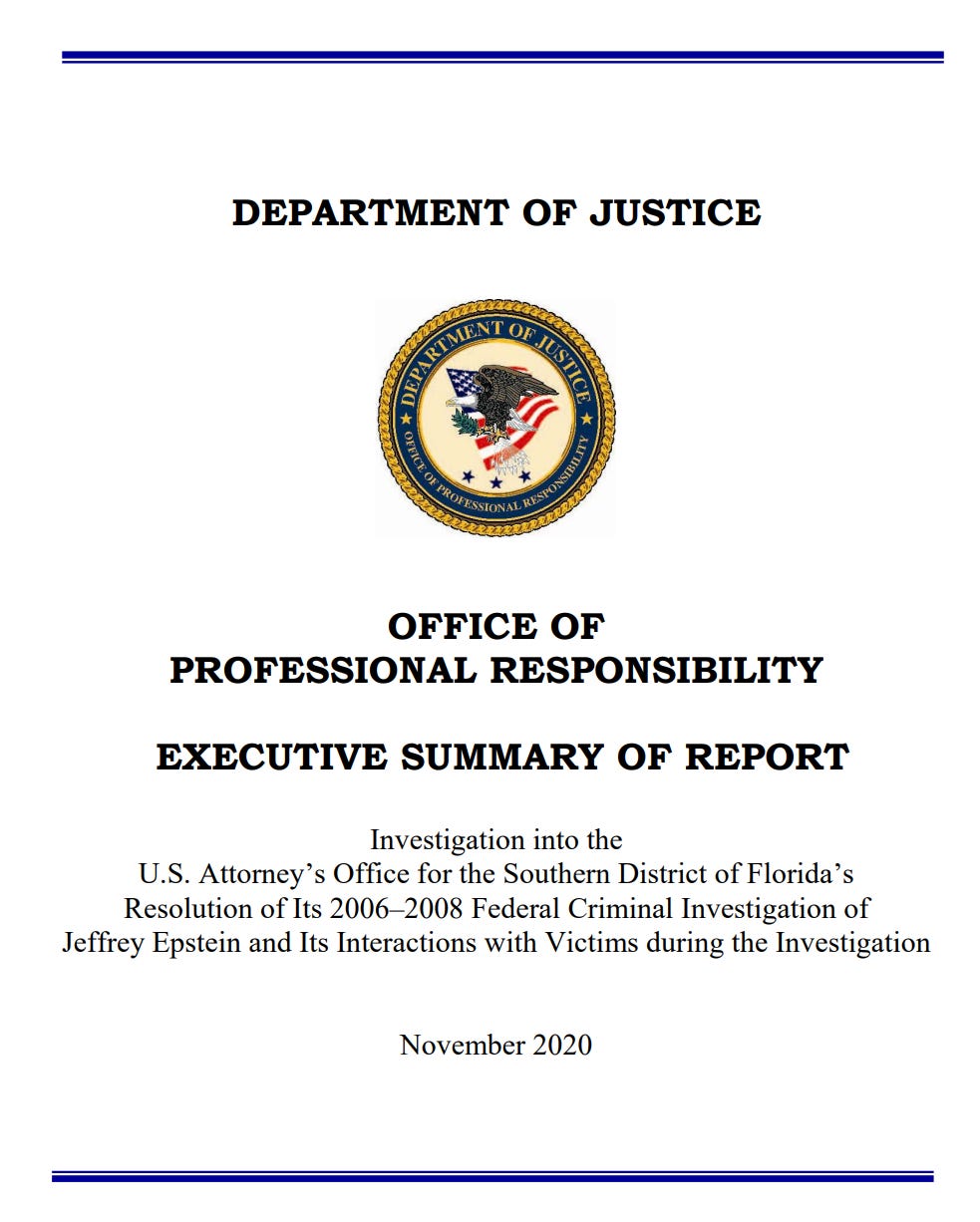
• According to the DOJ’s Office of Professional Responsibility, the decision reflected poor judgment rather than professional misconduct
Transparency Note
Only the Executive Summary of the DOJ’s internal report on the 2008 agreement is publicly available. The full report, which exceeds 300 pages, was provided to Congress and internal officials but has not been released for public review. We cannot know the reasons. What we can say is that limited transparency narrows what the public can independently verify. In a case already shaped by uneven institutional responses, the absence of the full report becomes another example of how institutional insulation can form, even unintentionally.
This is insulation created through fragmentation.
• State and federal confusion
• Conflicting internal evaluations
• Discretion applied without clear guidance
• Hesitation in the absence of coordination
No single person caused this outcome.
No single safeguard prevented it either.
What This Teaches Us About Institutional Drift
If we imagine Epstein’s insulation as the work of a mastermind, we lose the complexity. If we imagine it as pure drift, we miss the role of individual decisions.
The reality appears to live in a shifting spectrum that includes:
• deference and oversight
• hesitation and action
• fragmentation and coordination
• individual agency and structural inertia
Where institutions deferred to influence, hesitated, acted in parallel, and sometimes raised concerns without aligning, the case becomes a mirror rather than a mystery.
Insulation often forms through many small protections that were never meant to be protections at all.
A society can address these patterns only when it acknowledges both the drift and the design, both the pressures of the system and the choices of the people within it.
An Invitation to Reflect
As you read this, notice what it brings up: curiosity, discomfort or uncertainty.
You might also notice questions about your own assumptions.
If any section feels incomplete or quietly charged, run it through the TruthForge.
Ask yourself:
-What feels solid
-What feels unclear
-What deserves another angle
Your observations, questions and dissent may shape where we go next.
Quiet Close
One question.
One layer.
One careful look at how insulation forms inside large systems, sometimes through intention, sometimes through drift and often through a mix of both.
Thank you for walking this with us.
Next in the series
In Post 3, we turn our attention to the 2008 Non-Prosecution Agreement, the decision point that shaped much of what followed. We will walk through what the agreement actually said, who approved it, who questioned it, and why it has been described as one of the most unusual plea arrangements in modern federal history.
This is not a search for villains. It is a closer look at the machinery inside the justice system: the choices, constraints, disagreements, and blind spots that allowed accountability to bend at a critical moment.
We will use only verifiable documents and public records, and we will examine them with the same steady, unbiased posture we bring to every post in this series.
Truth moves quietly.
So will we, as we take the next step.
Sources and References
Department of Justice, Office of Professional Responsibility. Investigation into the U.S. Attorney’s Office for the Southern District of Florida’s Resolution of Its 2006–2008 Federal Criminal Investigation of Jeffrey Epstein and Its Interactions with Victims. Executive Summary, November 2020, pages ii–x.
Available at: https://www.justice.gov/opr/page/file/1336471/dl?